Developing database aims to improve access to Black health research in Canada

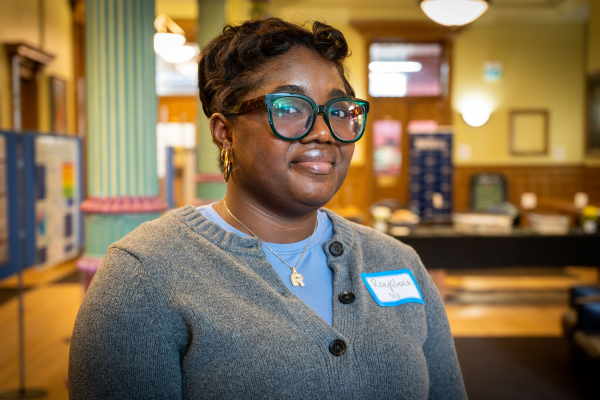
Rayshaun Whyte is part of an interdisciplinary team of student researchers, faculty and librarians developing the Black Canadian Health Research Database — a resource aimed at improving access to information on healthcare outcomes, race and policy development.
“I wanted to be part of something that didn’t just talk about these issues but actively worked to address the realities for Black people in the healthcare system,” says Whyte, a fifth-year undergraduate student majoring in psychology and anthropology with a minor in biology at the University of Toronto Mississauga.
The database will include more than 200 academic and community-oriented materials such as journal articles, podcasts, infographics, newsletters and policy documents. It is designed to fill a longstanding research gap on Black health in Canada, while also making it accessible for scholars, community members and advocacy groups.
Whyte presented key insights from the project during the poster sessions at the BRN Research Symposium on April 14. The project is supported by the Black Research Network’s IGNITE Grant, awarded to sociology associate professor Prentiss Dantzler of U of T Mississauga.
Led by the UTM Library’s David Gerstle and Maria Ruiz, the current development phase includes gathering and categorizing materials, which can be searched by keyword and topic. The database is designed accommodate diverse language and accessibility needs and learning styles, which was a driving factor in collecting materials available in various mediums.
Student researchers from the fields of psychology, anthropology, geography, sustainability and medicine are contributing to the project, which Whyte says opens broader conversations about healthcare access and the social determinants of health.
“Race was the starting point, but healthcare and your experiences with its systems are also shaped by gender, sexuality and class,” Whyte says. “We wanted to reflect that intersectionality.”
A prototype is expected by the end of summer, with a full launch planned for spring 2026.
“We want this to be a community effort, and that doesn’t just mean academics or advocacy groups but for anyone who identifies as Black, Caribbean, Afro-Caribbean and Black Canadian,” Whyte says.
Learn more about the interdisciplinary projects featured at the inaugural BRN Research Symposium.




Recent News