

‘Matching momentum:’ Black Research Network celebrates five years of supporting research excellence

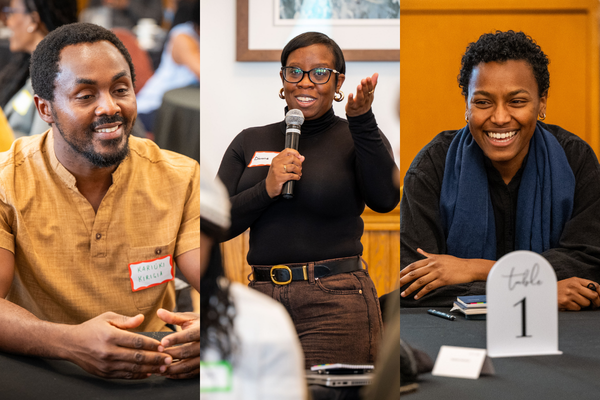
The Black Research Network (BRN) will mark five years of strengthening the research capacity of Black scholars at the University of Toronto in October.
For BRN Director R. Cassandra Lord, the network’s growth is rooted in a simple principle: recognizing the excellence Black researchers already bring to their work.
“Our mission is to promote Black research excellence because our members already arrive to the university as excellent researchers,” says Lord, an associate professor in the Department of Historical Studies and the Women, Gender and Sexuality Studies program at the University of Toronto Mississauga.
“The energy from the launch hasn’t slowed. It’s evolved, and we’re committed to matching that momentum as we grow alongside our members.”
The BRN was established in October 2021 in response to recommendations from U of T’s Anti-Black Racism Task Force and national dialogues that shaped the Scarborough Charter on Anti-Black Racism and Black Inclusion in Canadian Higher Education. It is the first research initiative of its kind in Canada.
Years before its launch, senior faculty recognized gaps in support for early-career faculty and Black students, calling for a space to foster academic development and build community beyond academic silos. In 2015, the Black Liberation Collective, a student advocacy group, played a significant role in drawing sustained attention to the need for stronger institutional action to address anti-Black racism and support Black representation on post-secondary campuses.
The BRN took shape when four renowned researchers and academic leaders came together to form the initiative: Lisa Robinson, dean of the Temerty Faculty of Medicine; Alissa Trotz, director of Caribbean Studies at New College; Maydianne Andrade, dean of the Faculty of Science at York University; and Rhonda McEwen, the new president and vice-chancellor of the University of Victoria. At the time, Andrade and McEwen were both at the University of Toronto.

Fueling the future of Black-led research
To date, the BRN has awarded $246,750 through its IGNITE Grant, which provides project seed funding for Black faculty, librarians, postdoctoral scholars, clinical scientists and medical research fellows/residents. A year-long faculty fellowship program has awarded a total of $110,000 since 2023, providing $10,000 per grant to support research engagement for tenure- and teaching-stream faculty.
“As we move forward, we are thinking critically about what it means to value faculty across all streams, especially those in the teaching stream, who may not see themselves reflected in traditional definitions of ‘what counts’ as ‘research,’” Lord says.
The BRN also offers academic career development workshops, including the BRN Academic Practice Lab, which helps faculty, graduate students and postdoctoral fellows build practical skills, access funding application insights and explore diverse academic pathways.
This year, the BRN went global, partnering with the Office of the Vice-President, International and the University of the West Indies to fund five research teams working in climate resilience, health and artificial intelligence.

Closer to home, it collaborates with university divisions on initiatives such as the Connaught Major Research Challenge for Black Researchers, an award of up to $250,000 established with the Connaught Fund to support Black-led teams tackling grand research challenges.
For Myrtede Alfred, BRN funding has been instrumental in getting research projects off the ground.
The BRN IGNITE Grant enabled Alfred and a PhD student to map patient journeys and collect pilot data on maternal care experiences of racialized patients in health-care systems across the Greater Toronto Area.
Seed funding is especially important in areas such as Black health, where limited Canadian data can make it challenging to establish the evidence base needed for larger research grants, Alfred says. Building on Alfred’s previous U.S.-based research, the project provided preliminary evidence needed to apply for more competitive grants.
“The BRN IGNITE Grant allows you to build collaborations and stronger expertise in a particular research area,” says Alfred, an assistant professor in the Department of Mechanical and Industrial Engineering in the Faculty of Applied Science and Engineering.
“For junior faculty, that’s really impactful.”

Alfred was also recently awarded a Connaught Major Challenge for Black Researchers Award to develop another project; a framework that will help Canadian hospitals address health-care inequities affecting racialized patients.
Since joining the University of Toronto in 2021, Alfred has attended the BRN’s research symposium and networking events, encouraging students to do the same.
“It’s an opportunity to see what colleagues in other departments are doing, network and meet mentors who are happy to share their experience,” Alfred says. “I’m grateful it’s something I’ve had access to during my time at U of T and to have a community.”
The BRN continues to build on its progress to support members. Suzi Oliveira de Lima, an associate professor in the Department of Linguistics, joined as the inaugural associate director, mentorship in July. A new advisory committee with members at different career stages will help shape programming reflective of evolving member needs.
“We continue to think about how access to the BRN from the start of your academic journey can make a difference in where you ultimately choose to continue your education, build a research career or even a path to leadership,” Lord says.
“The BRN is here to continue to create opportunities and community for our members to flourish.”

Recent News


